A Kubernetes Operator for Self-Hosted Cube Core
The Cube Core MicroK8s Operator
encodes self-hosted Cube Core as a declarative Kubernetes API. A CubeCluster
describes API replicas, refresh workers, Cube Store topology, model and Secret
references, storage, and service exposure. The controller continuously turns
that intent into standard Kubernetes resources and reports readiness back to
the custom resource.
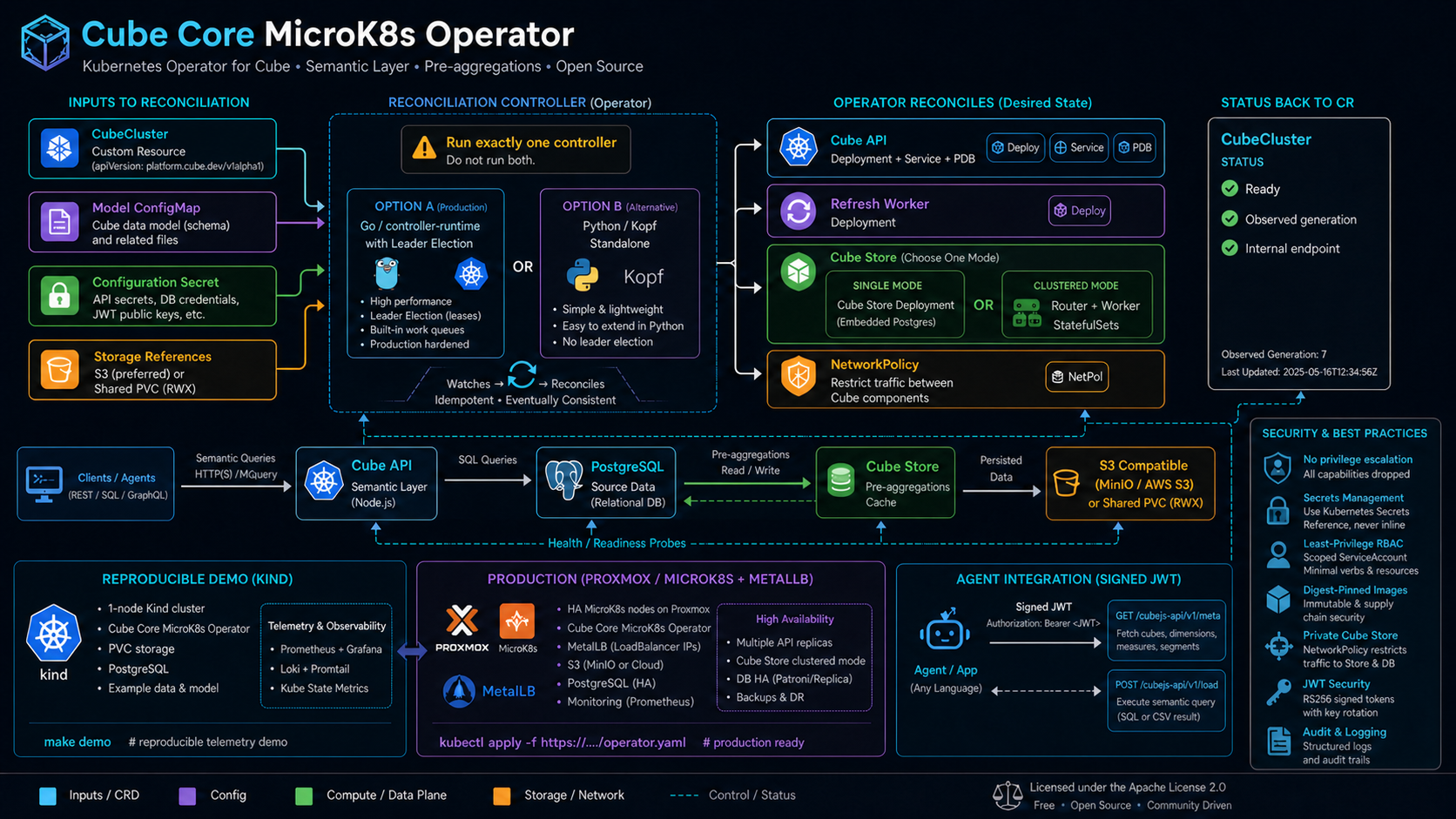
Why an operator instead of deployment YAML
A static manifest can start Cube, but it does not provide a durable ownership model. The operator validates referenced configuration, applies owner references, chooses single or clustered Cube Store resources, preserves allocated Service fields, removes resources made obsolete by topology changes, and calculates readiness from every expected component.
The platform.cube.dev/v1alpha1 API reconciles:
- Cube API Deployment, Service, and PodDisruptionBudget;
- a dedicated refresh-worker Deployment;
- either one Cube Store Deployment or router/worker StatefulSets;
- private services and a NetworkPolicy around Cube Store; and
- a Ready condition with observed generation and internal endpoint.
The operator reads model ConfigMaps and configuration Secrets but does not create credentials. This keeps database passwords and JWT signing material out of custom-resource specs and Git history.
One API, two controller implementations
The default controller is written in Go with controller-runtime and Kubernetes Lease leader election. It is the recommended production path because multiple manager replicas can coordinate safely. A separately packaged Python/Kopf controller implements the same resource contract as a readable, Pythonic alternative for teams that prefer rapid Python iteration.
Exactly one implementation may run at a time. Both controllers own the same Deployments, Services, StatefulSets, and status fields; running both would create reconciliation races. Switching therefore means deleting one controller Deployment, waiting for termination, and only then applying the other.
# Go/controller-runtime, the default
kubectl apply -k config/default
kubectl -n cube-system rollout status deployment/cube-operator

# Alternative Kopf controller: stop Go first
kubectl -n cube-system delete deployment cube-operator --wait=true
kubectl apply -k config/kopf
kubectl -n cube-system rollout status deployment/cube-operator-kopf
This dual implementation is useful beyond language preference: it documents which behavior belongs to the API contract and which belongs to a particular framework.
Storage and query topology
Cube API translates dimensions and measures from the model ConfigMap into SQL for the configured data source. Cube Store serves caching and pre-aggregation; the refresh worker updates those structures independently from request-serving API replicas.
Single mode supports an ordinary existing PVC and is appropriate for compact
installations. Clustered mode creates a router and multiple worker StatefulSets.
Its remote directory must be genuinely shared and concurrently mountable, or it
should use S3. Merely attaching the same ReadWriteOnce volume name to several
nodes does not create a distributed filesystem.
apiVersion: platform.cube.dev/v1alpha1
kind: CubeCluster
metadata:
  name: analytics
  namespace: cube
spec:
  modelConfigMap: cube-model
  configurationSecret: cube-configuration
  api: {replicas: 2}
  refreshWorker: {replicas: 1}
  cubeStore:
    mode: clustered
    workers: 2
    remoteStorage:
      type: s3
      s3:
        bucket: company-cube-prod
        region: us-west-2
        secretRef: cubestore-s3
Images in the examples are digest-pinned. Workload identity is preferable for S3; a referenced Secret is available where static credentials are unavoidable. Containers drop Linux capabilities and disallow privilege escalation, while Cube Store accepts only the component traffic selected by NetworkPolicy.
A telemetry demo that tests more than installation
The included Kind environment creates PostgreSQL, a collector with scoped Kubernetes read access, a semantic telemetry model, and Cube Core. The collector writes point-in-time pod observations. The E2E script verifies liveness, readiness, metadata compilation, and a real semantic query rather than stopping at “the pod is Running.”
git clone https://github.com/sqe/cube-microk8s-operator.git
cd cube-microk8s-operator

make verify
make kind-up       # Go controller
make kind-e2e
make kind-down

# The same demo through the Python implementation
make kind-up-kopf
make kind-e2e
make kind-down
The Kind scripts detect amd64 versus Apple Silicon arm64 nodes and select the matching digest-pinned Cube Store image. The demo API is mapped only to the local machine. Production DNS, certificates, firewall rules, backups, and public ingress remain explicit operator responsibilities.
Agents consume governed analytics, not database credentials
A local agent skill mints a short-lived Cube JWT and calls the Cube Core REST
contract. It first inspects /cubejs-api/v1/meta, then submits bounded semantic
queries to /cubejs-api/v1/load. This lets an agent use named measures and
dimensions without receiving PostgreSQL credentials or permission to execute
arbitrary SQL.
Cube's hosted Chat API and official Cloud skills are a separate product boundary. This project documents them as optional Cube Cloud integrations; it does not claim those hosted features are part of open-source Cube Core.
Publication and operational boundaries
The repository includes an OperatorHub/OLM path: bundle and catalog metadata, CSV install modes, validation, scorecard, Kind+OLM testing, image signing, and the community-operators pull-request workflow. Documentation states whether a release has actually been published rather than treating packaging instructions as publication evidence.
Before production use, test CRD upgrades, restore procedures, controller failover, Cube Store recovery, database limits, and model changes under the target workload. “Production-oriented” means these controls are represented; it does not replace environment-specific qualification.
Explore the project: GitHub repository · Architecture · Agent boundary